
A Model of Spiritually Based Elections
March 17, 2026
A Different Style of Election
At this moment, the United States is again in the midst of an election season. Across the country, campaigns unfold as candidates seek office and citizens prepare to choose those who will serve in positions of governance and leadership. Elections are an essential feature of democratic life, calling individuals to public service and inviting the population to take part in shaping the direction of society.
Yet the electoral process is often accompanied by intense struggles for power. Campaigns can become saturated with self-promotion, partisan rivalry, and identity politics. Public discourse frequently turns divisive, as competing visions for the future are advanced through persuasion, debate, and sometimes confrontation.
At the same time, another kind of election process is quietly taking place.
Across the world, Bahá’ís are preparing for the annual election of their National Spiritual Assemblies—the councils that guide the affairs of the Bahá’í community in each country. In the United States, this coming April will mark the 118th election of the National Spiritual Assembly of the Bahá’ís of the United States.
For many American Bahá’ís, the occasion invites reflection on how both the community and its electoral culture have evolved over the decades.
From its earliest days, the Bahá’í system of elections has been distinguished by several features: there are no nominations, no candidates, and no campaigning. Yet the spirit with which Bahá’ís approached these elections did not emerge fully formed overnight. In earlier periods of the American Bahá’í community, believers sometimes brought into their thinking patterns common in the wider society. Discussions could revolve around differing approaches to teaching the Faith or developing the community. Some might emphasize firesides and individual conversations, while others focused on large-scale teaching efforts. These were sometimes framed as competing priorities.
In reality, these various approaches had all been encouraged in the guidance of Shoghi Effendi, the Guardian of the Bahá’í Faith, who described them as complementary components of a single, unified process of growth.
Over the past three decades, the American Bahá’í community has experienced a profound shift in its understanding of collective effort. Guided by participation in the Global Plans—a coordinated series of initiatives advanced by the Universal House of Justice to shape the community’s process of learning—believers have increasingly come to see the many activities of community life not as competing strategies but as mutually reinforcing expressions of a single purpose—the advancement of the Bahá’í community and its contribution to the well-being of the wider society.
This spirit of unity is perhaps most visible in the Bahá’í electoral process itself.
An Election Without Campaigns
Imagine an election without nominations, candidates, or campaigning—an election conducted in a prayerful atmosphere and grounded entirely in principles of integrity and service.
For those accustomed to political contests marked by rivalry and partisanship, the Bahá’í system of elections may seem almost unimaginable. Yet every year it is quietly put into practice at gatherings known as National Conventions.
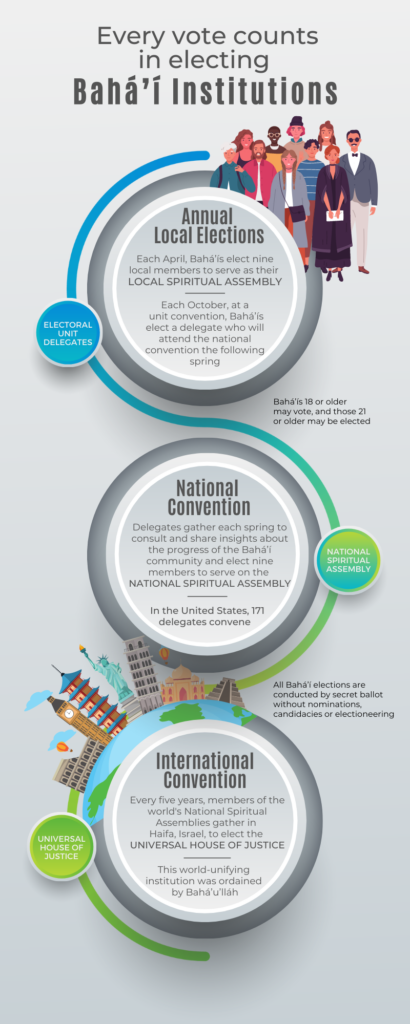
Delegates elected from communities across the United States gather to elect the nine-member National
Spiritual Assembly, the body that will guide the affairs of the national Bahá’í community for the coming year.
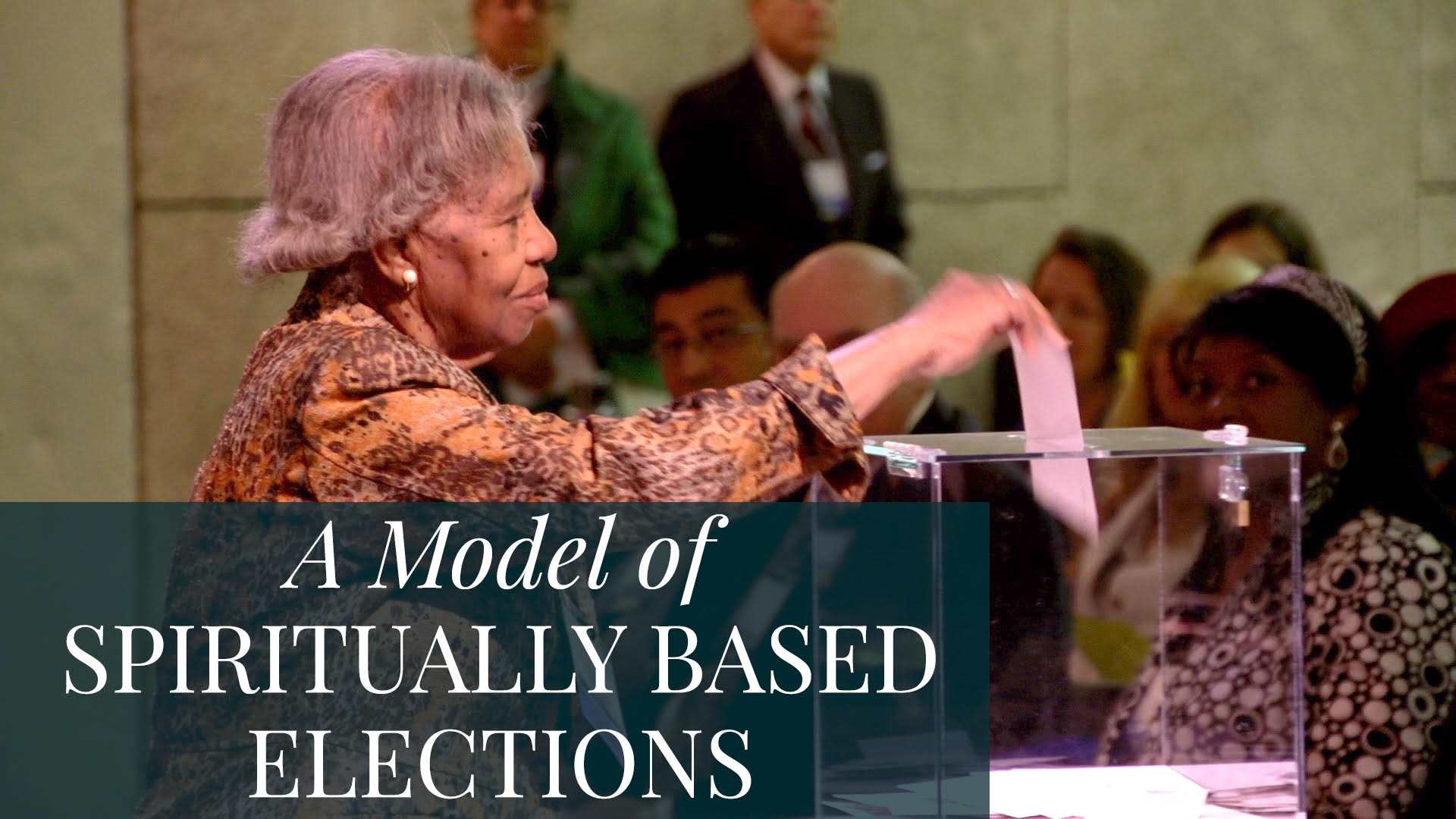
Each delegate participates in the election by secret ballot. There are no campaign platforms and no endorsements. Instead, delegates reflect prayerfully and independently, voting for those they believe possess qualities such as selfless devotion, a well-trained mind, recognized ability, and mature experience.
Every vote carries equal weight.
The delegates themselves reflect the remarkable diversity of the American Bahá’í community. Coming from geographic units across the country, they represent communities composed of people from virtually every ethnic, racial, and cultural background. Each delegate was elected by fellow Bahá’ís in a local “unit convention” held months earlier.
Those elected to serve on Bahá’í institutions do so entirely as volunteers. There is no clergy in the Bahá’í Faith, and the work of administration is carried forward through councils elected by the community.
Engagement in the Life of Society
While Bahá’í elections are distinctive, Bahá’ís do not withdraw from the civic life of their countries. On the contrary, they are encouraged to be active participants in the well-being and progress of society. Bahá’ís vote in public elections as individual citizens and take part in community-building efforts, public discourse, and initiatives that promote justice, unity, and the common good. At the same time, they seek to avoid partisan political involvement, refraining from campaigning for candidates or aligning themselves with political parties. Their aim is to contribute constructively to society while maintaining a spirit of cooperation and unity across the many viewpoints that exist within the broader community.
A Global System
Most National Conventions take place during the Festival of Riḍván, the twelve-day holy period commemorating Bahá’u’lláh’s declaration in 1863 that He was the Messenger of God for this age.
Every five years, however, the rhythm expands to a global scale. Representatives from more than 180 national Bahá’í communities gather at the Bahá’í World Centre in Haifa, Israel, to elect the Universal House of Justice, the international governing body of the Bahá’í Faith.
The first election of the Universal House of Justice in 1963 was likely the first truly global democratic election in history. Since then, each successive election has involved an ever more diverse body of participants representing people from every region of the world.
A Model for Governance
At a time when trust in public institutions is declining in many parts of the world—and when electoral processes are sometimes overshadowed by polarization or corruption—the Bahá’í approach to elections offers a strikingly different model.
As the Universal House of Justice has observed, the Bahá’í community is to increasingly offer a living example of unity in diversity. Millions of believers from many nations, cultures, and backgrounds participate in consultative decision-making and collective service, demonstrating that a single, global society can operate in harmony while respecting differences. This experience provides practical evidence of Bahá’u’lláh’s vision of a united humanity and offers a model from which individuals and the institutions that serve them may draw hope and inspiration.
The purpose of governance is not competition for power but collective service to humanity. Its methods are designed to cultivate unity rather than division. Its participants seek not victory over opponents but the selection of those best able to contribute to the common good.
For Bahá’ís, their system is not simply an internal administrative practice. It is an early expression of principles they believe will one day help shape a more just and unified global society.
You may also like
You may also like
Audiobook: The Baha’i Response to the Crisis of Our Time
You may also like