
Tahirih’s Impact
October 19, 2021
Issues of Society
Tahirih’s Impact
Source: ‘Abdu’l-Baha, Sparks Among the Stubble (1924)
Constance Elizabeth Maud was an English writer with a great interest in the Suffrage movement, who met ‘Abdu’l-Baha in London at Lady Blomfield’s, 1911. She recounted this story from her experience:
One day at my earnest request he told me her [Fatimah Baraghani known as Tahirih] story. … She was the living link of his youth with the earliest steps of the Bahai movement, for she, like His father, had first received the light from the Bab, the prophet precursor of Baha’u’llah. After the martyrdom of the Bab, Qurrayu’l’Ain had followed Baha’u’llah until she too was martyred for the cause. The story of his remarkable countrywoman was one ‘Abdu’l-Baha loved to tell to English and American women, for, placing them in the vanguard of civilisation, he felt assured they must rejoice to claim as a sister this first Persian feminist and courageous pioneer. In His simplicity ‘Abdu’l-Baha could not conceive of women in these enlightened countries who might be anti-suffragists and anti-feminists, and we forbore to lower his high ideal of English Women.
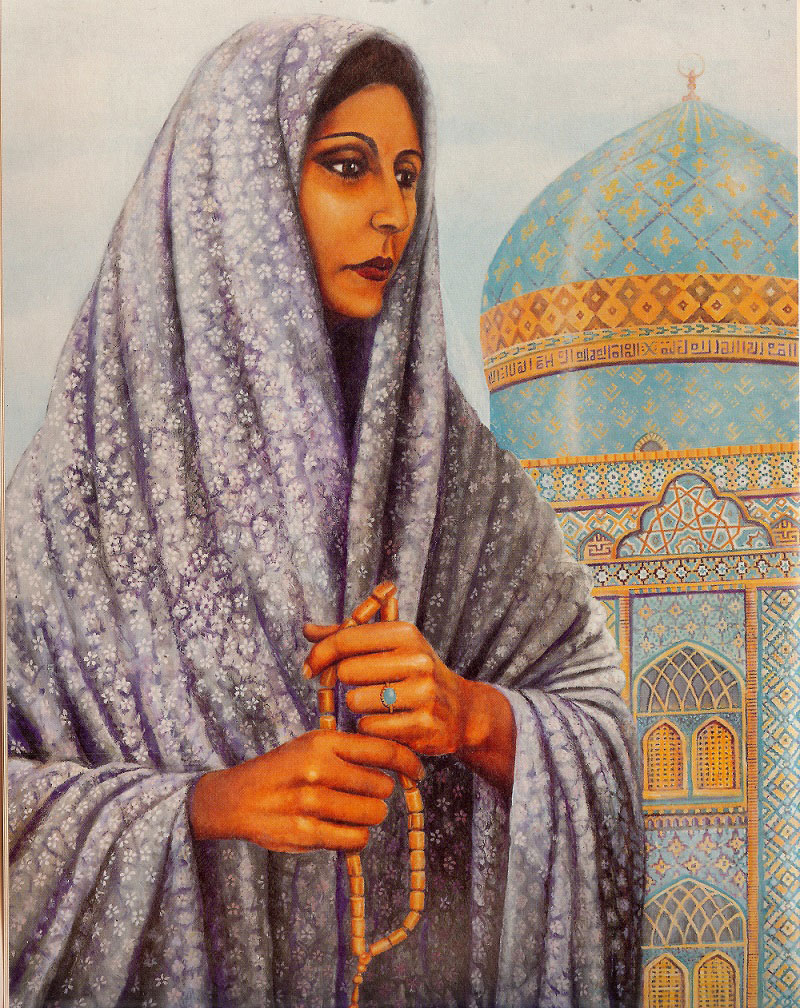
..when [‘Abdu’l-Baha] was just three or four years old, he used to sit on Tahirih’s lap in His Father’s house in Tehran. Tahirih accepted the teachings of the Bab in her twenties, to the consternation of her father and her husband, and became one his most fearless and brilliant advocates. She was a poet, renowned for her learning and her skill in argument. At a conference near the village of Badasht, in 1848, she shocked her fellow believers by appearing before the all-male gathering without a veil. One of them felt so scandalized that he slit his own throat.
By imposing this new image of equality on the Babis, Tahirih forced them to make a critical break with the past. On her way back to Tehran she was arrested, sent to the capital, and brought before the king, Nasiri’d-Din Shah. If she would only renounce the Bab and return to Islam, His Imperial Majesty told her, he would make her his bride. She turned him down with a poem:
Kingdom, wealth, and power are for thee,
Beggary, exile, and loss are for me.
If the former is good, it’s thine.
If the latter is hard, it’s mine.
They imprisoned her for four years.
The day before they killed her, the Shah summoned her again. Again she rebuffed him. They strangled her with a scarf and threw her body down a well. The Times of London reported her death on October 13, 1852. She was thirty-six years old. Tahirih remained defiant until the end. “You can kill me as soon as you like,” she said, as she faced her murderers, “but you cannot stop the emancipation of women.”